

Social media is usually associated with public profiles, real names, profile photos, and visible social connections. Over time, this model has become the default way people think about online interaction. However, anonymous social media follows a different approach—one that reduces or removes public identity and places greater emphasis on content, ideas, and short-term interaction.
Understanding how anonymous social media works, and how it differs from traditional social platforms, helps explain why anonymity is often limited, carefully controlled, and rarely offered as a core feature.
What Anonymous Social Media Means?
Anonymous social media refers to platforms or features that allow users to post content without publicly displaying their real name or a permanent personal profile. Posts may appear under temporary usernames, system-generated labels, or with no visible identifier at all.
It is important to understand that anonymity is usually public-facing, not absolute. Other users cannot see who created a post, but the platform itself may still retain internal data for moderation, safety, and compliance purposes. This distinction is central to how anonymous platforms function and why they differ so strongly from traditional social networks.
How Traditional Social Media Is Structured
Traditional social media platforms are built around long-term identity. Users create profiles that persist over time and are often linked to real-world identity through names, photos, or social graphs.
Content on these platforms is closely connected to the profile that publishes it. Visibility is influenced by follower counts, engagement history, and algorithmic signals tied to user identity. Over time, this structure encourages:
- Personal or professional branding
- Audience building
- Long-term content visibility
- Reputation-based interaction
Because identity is public and persistent, accountability is also more visible. User behavior is associated with a known profile, which influences how moderation, reporting, and enforcement are handled.
How Anonymous Social Media Is Structured
Anonymous social platforms take a very different approach. Instead of centering the experience around profiles, they focus on conversations, topics, or moments.
Identity, when present, is often temporary or minimal. A username may exist only within a single discussion or reset periodically. Some platforms remove visible identifiers altogether and allow posts to stand on their own.
This design reduces long-term identity building and shifts attention toward the content itself. As a result, participation often feels more spontaneous and less tied to personal reputation.
Key Differences Between Anonymous and Traditional Social Media
The differences between these two models go beyond identity and affect how content is created, shared, and moderated.
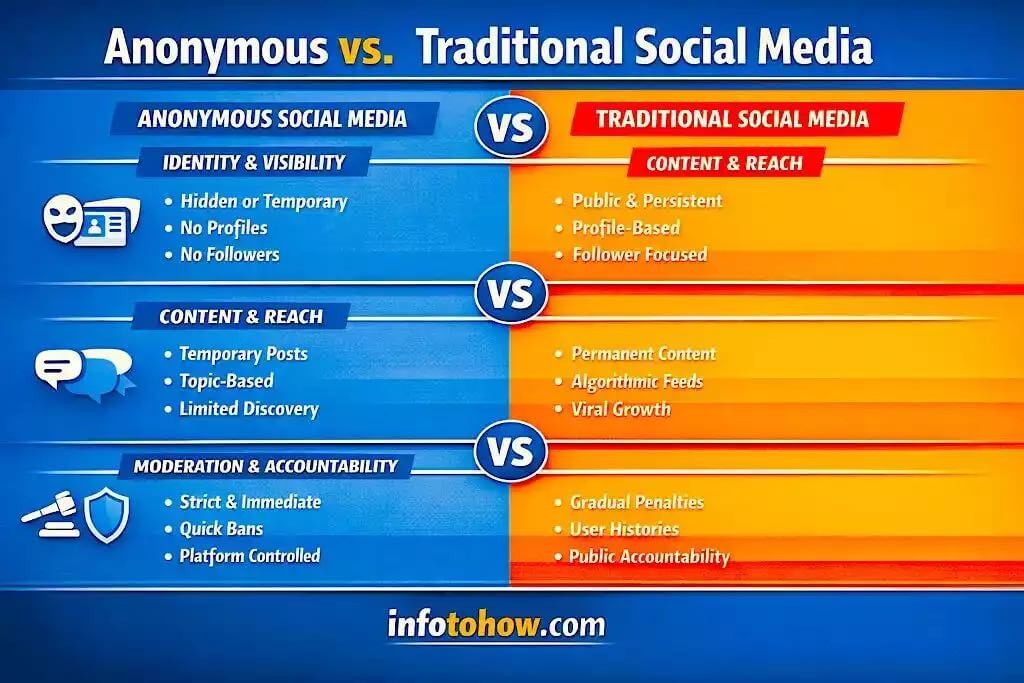
Why Anonymous Platforms Require Stronger Controls
Removing public identity changes how people behave online. While anonymity can encourage honest expression, it can also increase the risk of spam, harassment, or misuse.
To address this, anonymous platforms often introduce stricter controls, such as posting limits, restricted interactions, or aggressive content filtering. These measures are not flaws—they are structural requirements that make anonymous environments sustainable.
Without these safeguards, fully anonymous platforms tend to become unstable or unusable at scale.
Examples of Partial Anonymity in Modern Platforms
Most large platforms avoid full anonymity, but many incorporate limited anonymous features within a broader identity-based system.
Examples include:
- Anonymous question submissions
- Feedback tools where names are hidden
- Temporary posting modes
- Discussion features where identity is masked from other users
In these cases, anonymity is carefully scoped. Users experience privacy, but the platform maintains oversight.
Benefits of Anonymous Social Media
Anonymous social media can lower barriers to participation. Users may feel more comfortable expressing opinions, asking questions, or discussing sensitive topics when identity is not central.
Other benefits include:
- Reduced pressure to maintain a public image
- Less focus on popularity metrics
- More idea-centered discussions
- Lower long-term reputational risk
These advantages explain why anonymity continues to reappear in various forms across online platforms.
Limitations and Trade-Offs
Anonymity also introduces clear limitations. Content reach is often restricted, posts may be removed quickly, and accounts can be limited without much warning. Long-term influence is difficult to build, and interaction depth may be constrained.
These trade-offs are intentional. Anonymous social media prioritizes safety and control over reach and permanence.
Traditional social media, by contrast, offers greater visibility and continuity but exposes users more directly to public judgment and long-term consequences.
Why Major Platforms Avoid Full Anonymity
Large social platforms must balance user safety, legal obligations, advertiser trust, and community standards. Full anonymity complicates all of these areas.
As a result, most platforms treat anonymity as a feature, not a foundation. It is introduced selectively, monitored closely, and often limited in scope. This approach allows companies to offer privacy-focused interactions without losing control over moderation and compliance.
Which Model Is More Sustainable Long-Term?
Traditional social media remains the dominant model because it supports monetization, community building, and long-term engagement. Anonymous social media exists as a complementary system rather than a replacement.
In practice, many platforms blend the two approaches, offering identity-based profiles alongside controlled anonymous features. This hybrid model reflects the strengths and weaknesses of both systems.
Final Thoughts
Anonymous social media is not a hidden alternative to mainstream platforms. It is a deliberately constrained design choice that removes public identity while increasing moderation and oversight.
By comparing anonymous and traditional social media side by side, it becomes clear why anonymity is offered cautiously and why most platforms treat it as a limited capability rather than a core identity model.
Understanding these differences helps set realistic expectations and explains why anonymity online is often more controlled than it appears.